
What is “Growth Engineering”?
Growth Engineering is a scientific, data-driven methodology used to engineer holistic, sustainable growth (i.e., Functional Growth). It follows a series of principles which helps businesses re-engineer how their people and operations are arranged and interact.
What are the benefits of Growth Engineering?
Growth Engineering unlocks the unrealized potential of the organization's people, removing obstacles, facilitating innovation, and creating synergies, which enables businesses to perform at an exponentially higher level.
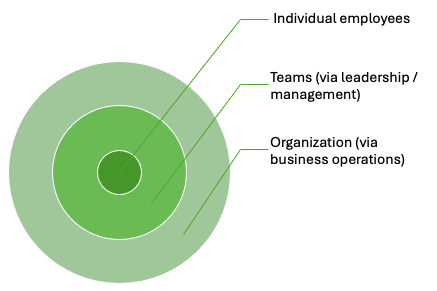
It facilitates real, sustainable growth in all business units, from the individual and small teams to the entire organization.
A small sampling of the things Growth Engineering does is:
Frees managers from firefighting to allow them to focus on high-value issues.
Replaces ineffective school-style training and onboarding with just-in-time job support to improve quality and productivity.
Creates built-in, near real-time feedback and evaluation processes, transforming them from sporadic, subjective, and often negative experiences into positive, enabling, and rewarding ones.
Nurtures an organizational culture that features robust critical thinking, problem-solving, decision-making, and strategic thinking at all levels of the organization.
Emphasis is placed on improving the quality of operations and employee competencies (qualitative growth) to drive the outcomes needed to achieve business objectives (quantitative growth).
What are the principles of Growth Engineering?
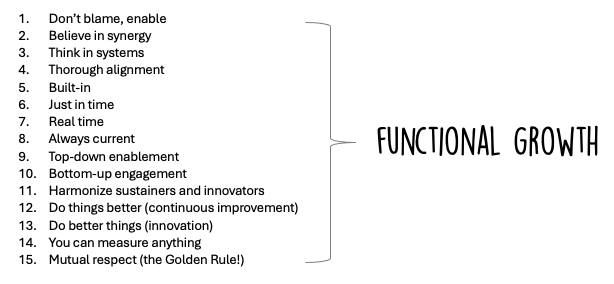
Growth Engineering is built on a series of principles which dictate how things are done. The more faithfully they are followed, the more effective and powerful the results will be.
1. Don’t Blame; Enable!
Growth Engineering is lubricated by trust, transparency, and teamwork. Blaming people when performance is below expectations is not only lazy, it’s incompetent. But why?
Because poor performance is an organizational problem.
But what about bad actors? Well, if bad actors are infiltrating your business, then the root cause likely lies in the hiring process—an organizational issue. And if you are not weeding out the bad actors, that’s an organizational issue too.
What about in other cases of poor performance? The root causes for these are also found somewhere in the organization.
Are the wrong people being hired?
Is onboarding and training not delivering?
Is the organizational structure or culture getting in the way?
Are unsuitable people being assigned to new roles or promoted?
These are organizational problems. To fix them you must remove the organizational root causes.
Further, fixing organizational problems requires bottom-up cooperation—teamwork. This is only possible if there is top-down trust and transparency. Employees who are afraid of blame or evaluated against each other will not feel it safe or beneficial to flag issues or cooperate in fixing them. Focusing on building the necessary trust, transparency, and teamwork necessary to identify and fix such organizational issues is a key benefit of Growth Engineering.
Another benefit? Enabling people rather than blaming them will transform the workplace environment into a vibrant engine for growth!
2. Believe in synergy
1+1=5. Plus one more = 15. That’s the math of synergy. Synergy is the torque generated through Growth Engineering. And this torque grows exponentially as you build out and maintain your Growth Engines.
This is not hype or deception. It’s science. Growth Engines need to be strategically built and methodically maintained but when humming along they produce fantastic results.
3. Systems thinking
Systems thinking means focusing on the collective optimization of all components to deliver the best end result (output) from the system. Individual component optimizations that hurt the output of the larger system are to be avoided.
“If your system isn’t delivering the desired results, then it’s the wrong system, regardless of intent. System results speak for themselves, they are non-debatable. If you want different results, you need a different system.”
4. Thorough alignment
Thorough alignment means:
all actions in the organization are aligned with the higher-level strategies and policies for the organization to perform at a high level, and
all top-level strategies and policies are effectively cascaded down through the organization so everyone is aware of how their role contributes.
5. Built-in
Built-in means that the competencies and support needed by people to execute a workflow are built in to that workflow. The acquisition of any competency or support that cannot be built into that workflow is a prerequisite.
The provision of prerequisite competencies or support is done in a way that will provide the necessary competence in a timely manner, so people are not up-skilled so early they lose the skill before they’re required to use it.
Mechanisms for maintaining and supporting prerequisite competencies are also built into that workflow (reference material, pointers, quick reference guides, etc.).
Built-in also means things like quality and compliance are built into workflows in a way that makes following them routine. And avoiding them will be flagged by the checks and balances within the workflow.
6. Just-in-time
Just-in-time is the concept of providing what is needed, when it’s needed, how it’s needed, and with the appropriate amount/intensity needed to execute the workflow. This applies whether what’s needed is a part, device, supply, training, feedback, guidance, information or assistance.
7. Real-time
Real-time means input such as feedback, information, evaluations, and metrics are undertaken at the moment of the event. This is equivalent to “striking while the iron’s hot”! The closer input is to the event or need, the more efficient and effective it is.
8. Always current
Always current means that whenever or wherever a decision, change, modification, or adjustment in the organization is made, that change is promptly propagated throughout the business to update all relevant materials.
In particular, all related workflows are updated in a manner that will enable the worker to seamlessly handle and incorporate the change.
9. Top-down enablement
Top-down enablement goes hand in hand with bottom-up engagement (see below). Top-down enablement means rather than managers being order-givers and direct reports being order-takers, direct reports become aligned objective executers and managers become enablers, meaning they enable their direct reports to execute on the objectives.
To facilitate top-down enablement, as much of the administrative and supervisory workload as possible is redistributed and automated, and firefighting is reduced through proper problem-solving methodology, freeing up managers to focus on high-value enablement of their reports.
Note that almost all employees will wear two hats: for one activity they will be an enabler (supervisor/manager) and for another they will be an executer (a direct report to another person).
10. Bottom-up engagement
Bottom-up engagement goes hand in hand with top-down enablement. Bottom-up engagement is achieved by implementing proper problem-solving methodology throughout all levels of the organization to shift the responsibility and authority to identify, escalate, and solve (when appropriate) problems to the people who are facing those problems.
There are built-in mechanisms in place to enable workers to efficiently and effectively communicate with their supervisors and other related staff to identify problems and solve them or get the organization to solve them.
Bottom-up engagement is also about making bottom-up continuous improvement and innovation part of the corporate culture. There are built-in mechanisms in place to enable workers to efficiently and effectively communicate their insights and ideas to the organization where they are properly evaluated and acted upon. How those insights and ideas are being handed is made transparent.
Bottom-up engagement means people are empowered to participate in improving the workplace in line with top-level strategies and policies with their managers focusing on enabling them to do so.
11. Harmonize sustainers and innovators
Many organizations don’t realize they’re engaged in an eternal battle between “Sustainers” and “Innovators”.
Innovators are those people who disrupt the here and now to ensure the organization’s viability into the future.
Sustainers are those people who make sure what the innovators have already established continues to run smoothly.
So what’s the problem?
Well, when people lose sight of the big picture, they become short-sighted.
Sustainers are tasked to check boxes, but if they become short-sighted they’ll forget why they’re checking boxes in the first place. Box-checking become the goal rather than a way to achieve the actual objective. Many Sustainers continue to dutifully check boxes when the objective for doing so has vanished long ago.
When short-sighted, a Sustainer will consider any change to “the way things are done” as a threat. And so, they tend to view Innovators as disruptive rule-breakers who get their thrills by trashing and destroying a perfectly good status quo. Fraternizing with, let alone cooperating with, such outlaws is out of the question.
The job of Innovators is to constantly look for ways to make things better. But they’re also prowling for better things to do. Change is their name. Often really big change. To get such changes implemented, they’ll work closely with the Sustainers to shake out the kinks and get everything running smoothly again in the new direction.
If Innovators become short-sighted, however, they’ll act more like a bull in a china shop than trustworthy guides into the future. They’ll become drunk on change for change’s sake. Their lust for change will blind them to organizational needs and objectives. Instead of valued partners, they’ll view Sustainers as old-fashioned stick-in-the-muds who just get in the way.
Things might not be that bad in your organization, but it likely suffers from some of the symptoms. One common problem is putting the wrong type of person into a position. Roles that require innovation will be useless if assigned to a Sustainer. And putting an Innovator in charge of managing routine operations will cause a lot of stress for everybody.
Thus, Growth Engineering focuses on harmonizing and resonating the Yin and Yang between Sustainers and Innovators—making them an awesome partnership that drives synergies and exponential growth.
12. Do things better (continuous improvement)
Continuous improvement is the act of always looking for and thinking of ways to make incremental improvements. This is done in a systematic and methodical way that is built into operations. It is supported by the problem-solving discipline.
13. Do better things (innovation)
Innovation is the act of purposefully exploring and discovering significantly new and different ways of doing things to solve difficult problems or unlock new possibilities. This is done in a systematic and methodical way that is built into operations. It is supported by the problem-solving discipline.
14. You can measure anything
Measurement is learning more about the state of something. The purpose of measurement is to gain more information to make more informed decisions. Perfect precision in measurement (other than counting in some cases) is not possible or necessary. Any information, no matter how general, is more informative than no information. Growth Engineering incorporates as much information gathering (measurement) as is needed to achieve the stated objectives.
This information is used to track progress, verify assumptions, answer unknowns, and reveal new unknowns to better reveal the current state and inform decision-making.
15. Mutual respect (the Golden Rule!)
Treat others how you want to be treated and act in the way we want others to act. Sounds obvious. But you know what they say… common sense ain’t always common.
How is Growth Engineering implemented?
Growth Engineering is implemented via Growth Engines.
Next page: What is a Growth Engine?