
What is “business growth”?
"Growth" is top-of-mind for most business leaders. But for many, growth just means increased revenue or more customers.
Of course, this is usually how business success is measured. But how did we achieve those results? And can we continue to achieve these results, or do even better?
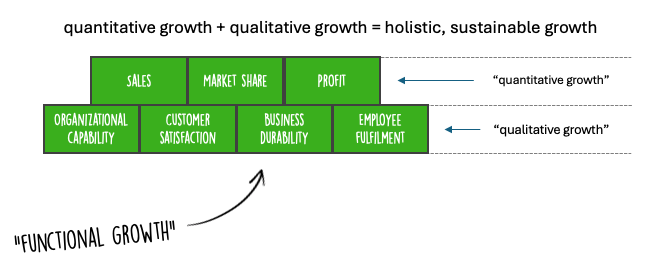
What about, organizational capability, business durability, customer satisfaction, fulfilled employees… sustainable profits? Aren’t these also important indicators of “growth”?
What is “Dysfunctional Growth”?
“Functional Growth” is is where qualitative growth is driving quantitative growth. We can think of this like a tree, where the roots of the tree are strong and support the tree as it grows.
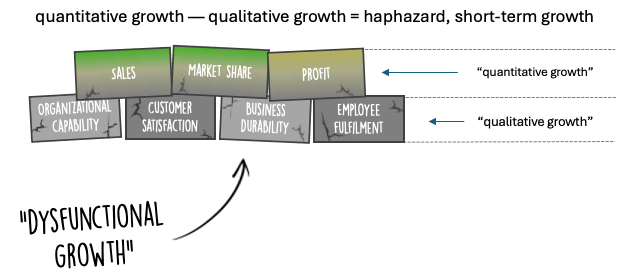
But when the roots are weak or damaged, we see “Dysfunctional Growth”. This is growth that looks good on the surface, but underneath, things aren’t what they seem.
It’s growth that’s happening despite the people and operations, rather than because of them.
And the trouble with this is that eventually, our tree can’t grow to it’s potential. Or even worse, it withers and dies.
What causes Dysfunctional Growth?
Dysfunctional Growth is like a messy garage. Over time, the clutter becomes worse and it becomes really difficult to find anything. The messier it gets, the more resistance you feel to sorting it out.
Eventually, you can’t even fit your car in there!
Then one day there’s an emergency and you can’t find what you need or you can’t get your car safely out of the storm and into the garage.
Applying the messy garage analogy to business, Dysfunctional Growth can manifest itself in many ways, such as:
suboptimal operations
bad habits
workarounds created by employees to get by
legacy systems that become entrenched and hard to remove, and
ineffective methodologies that become the de facto way of doing things.
What are the symptoms of Dysfunctional Growth?
Not all growth is created equal. While increased revenue can deliver short-term success, a business that sacrifices other objectives to achieve these goals will often develop unwanted symptoms.
Businesses experiencing any of these symptoms are suffering from “Dysfunctional Growth”.
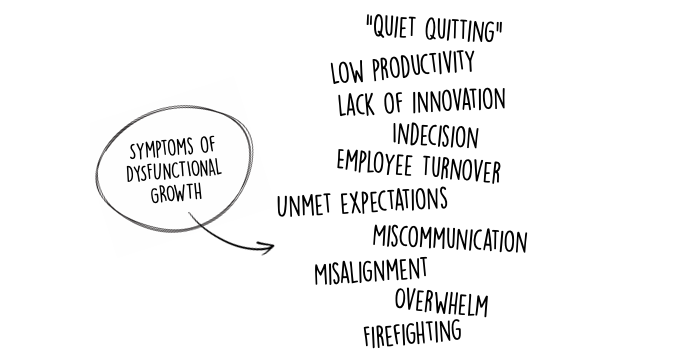
Of course, these symptoms are the norm. Who hasn’t worked in a business in which this is experienced daily? But is “the norm” what we really want? Fifty years ago, it was “normal” to smoke and drive around without seatbelts—but we’ve changed our beliefs on that. Can we really claim to be successful when there’s so much turmoil within our organizations? (Even the most successful companies would admit they struggle with many of these symptoms).
Dysfunctional Growth is growth, but at a cost.
And when we experience Dysfunctional Growth, we’re actually limiting our long-term growth.
Is Functional Growth realistic?
So, you might be thinking “well that’s all well and good, but is Functional Growth realistic?”.
Well, the answer is a resounding “yes”!
But it won’t happen by accident—you have to want it, plan for it, and continually nurture it.
There are companies that have engineered their operations to produce Functional Growth in part or all of their operations. A famous example is the Toyota Production System developed by Toyota.
Why is it difficult to achieve Functional Growth?
The most difficult thing about achieving Functional Growth is the mindset change at the top. Once that’s in place, the rest is just a matter of analyzing, planning, implementing, and iterating.
(One thing to emphasize is what we mean by “the top”. If we’re trying to achieve Functional Growth as a team, then the person whose mindset needs to change would be the team leader. As a department, it’s the department manager. As an entire company, it’s the C-suite.)
How do we achieve Functional Growth?
Instead of doing “more of the same”, we’d like to propose an alternative: “Growth Engineering”.
Growth Engineering is a scientific, data-based methodology used to engineer holistic, sustainable growth (i.e., Functional Growth). It is built by following a series of principles by which a business re-engineers how it’s people and operations are arranged and interact.
Next page: What is Growth Engineering?